Why Thread Lifting Is Not Just About the Number of…
Does using more threads mean better lifting results? Dr. Han Kook Kim of EGO Clinic explains how facial structure, tissue condition, thread selection, and lifting direction influence thread lift planning.
2026.10.24
EGO CLINIC · DOCTOR'S INSIGHT
Why Thread Lifting Is Not Just About the Number of Threads
A Doctor's Guide to Facial Structure, Lifting Direction, and Natural-Looking Results
When patients consider a thread lift, one of the first questions they often ask is: "How many threads will I need?"
It is an understandable question. The number of threads is easy to compare, and treatment packages are often presented in terms of how many threads are included.
However, I believe that this is not where the discussion about a good thread lift should begin.
In my practice, I first look at the patient's facial structure, the pattern of tissue descent, skin condition, and the balance between different areas of the face. Only after understanding these factors do I consider which threads to use, how many may be appropriate, and in which direction the tissues should be supported.
A thread lift is not simply about placing more threads. It is about making a treatment plan that corresponds to the face in front of me.
1. Why Thread Count Does Not Tell the Whole Story
It is tempting to assume that more threads will produce a stronger lifting effect. But the relationship between thread count and the final result is not that simple.
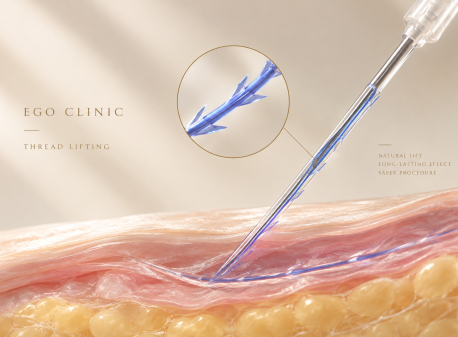
Threads are medical devices designed to engage and support tissue. Their performance depends on several factors, including their structure, placement, direction, tissue characteristics, and the amount of support required.
Imagine two patients who both have concerns about their lower face. One may have relatively good skin elasticity but noticeable tissue descent around the jawline. Another may have thinner skin, reduced facial volume, and a different pattern of midface descent.
Giving both patients the same number of threads, using the same design and placement strategy, would not necessarily be the most appropriate approach.
The important question is not simply how many threads are used, but whether the treatment plan addresses the patient's actual anatomical concerns.
Thread count is one part of treatment planning. It should not be used as a substitute for an individual assessment.
2. Facial Sagging Is Not the Same for Everyone
Facial aging is a complex process. It involves changes in skin quality, subcutaneous fat, retaining structures, facial support, and the relationship between different facial compartments.
As these changes progress, the face may develop different visible patterns:
Midface descent
Changes in the midface may contribute to a less defined cheek contour, a heavier appearance around the nasolabial fold, or changes in the transition between the lower eyelid and cheek.
Lower-face laxity
Tissue descent around the lower face may affect the jawline and create a heavier appearance near the jowls.
Changes in facial volume
Some patients have volume loss or redistribution that makes the face look tired or less supported. In these cases, lifting alone may not address every concern.
Skin quality and elasticity
Skin thickness, elasticity, and overall tissue condition can influence how a treatment is planned and what kind of result may realistically be expected.
These patterns can overlap. That is why I do not approach every patient with the same lifting design.
3. Four Factors I Consider Before a Thread Lift
Before discussing thread selection or quantity, I consider four broad aspects of the face. They help organize the assessment, although they do not replace a full medical examination.
① Midface Support
I examine the position and contour of the cheek area, the relationship between the midface and lower eyelid, and whether tissue descent is contributing to the patient's concerns.
② Lower-Face Descent
I assess the jawline, jowl area, and the distribution of soft tissue around the lower face. The goal is to understand where support may be useful rather than simply pulling the entire face upward.
③ Tissue Characteristics
Skin thickness, elasticity, tissue mobility, and the patient's individual anatomy all matter. A treatment approach suitable for one tissue type may not be suitable for another.
④ Overall Facial Balance
A face should be considered as a whole. Improving one area without considering the surrounding areas can create an unbalanced appearance.
I call this way of organizing the assessment the EGO FACE STRUCTURE MAP. It is a clinical planning framework I use to explain why facial structure and tissue condition should be considered before choosing a lifting technique.
It is not a separate medical device or a patented procedure. It is a way of making the reasoning behind an individualized treatment plan clearer.
4. Why Lifting Direction Matters
Another important part of thread lift planning is direction.
A thread lift is not simply a matter of pulling the skin upward. The direction of placement and the way tissue is supported must be considered in relation to the patient's anatomy and the intended treatment area.
Different areas of the face have different anatomical structures and movement patterns. A lifting direction that may be appropriate for one region cannot automatically be applied to another.
The design also needs to account for the desired contour. Excessive or poorly planned traction may create an unnatural appearance, while insufficient support may fail to address the patient's main concern.
This is why I consider the entry point, direction, placement plane, and tissue engagement together rather than treating them as isolated decisions.
The appropriate approach depends on the thread being used, the patient's anatomy, and the physician's clinical assessment. There is no single direction that is ideal for every face.
5. Choosing the Right Thread for the Right Purpose
Not all threads are identical. They may differ in material, structure, design, and intended use.
Some threads are designed with structures that engage tissue, while others have different configurations and purposes. The choice should be based on the treatment objective and the patient's individual condition.
When discussing thread selection, I consider questions such as:
• What area are we trying to address?
• What is the patient's tissue condition?
• What type of support is appropriate?
• Is the selected thread suitable for the intended placement?
• What limitations should the patient understand?
A thread should not be selected simply because it is more expensive, more widely advertised, or used in a larger quantity.
The product, technique, and treatment plan should make sense together.
6. When More Threads May Not Be Better
More threads do not automatically mean a better result. Increasing the number of threads without a clear clinical reason may add treatment complexity without necessarily improving the outcome.
Thread lifting also has limitations. It cannot replace surgery when a patient has substantial skin excess or advanced tissue laxity. It may not adequately address significant volume loss, poor skin quality, or every cause of facial aging.
In some cases, a combination of treatments may be considered. In others, a different procedure or no procedure at all may be more appropriate.
I believe that explaining what a thread lift cannot achieve is just as important as explaining what it may help improve.
7. What Patients Should Ask Before Treatment
If you are considering a thread lift in Korea, I recommend asking more than just how many threads are included in the treatment.
Questions worth asking during your consultation
1. What specific facial changes are you trying to address?
2. Why is this particular thread suitable for my condition?
3. How will the placement direction be determined?
4. What are the realistic limitations of this treatment?
5. Who will perform the procedure?
6. What complications or recovery issues should I understand?
7. Are there alternative treatments that may be more appropriate?
A good consultation should help you understand the reasoning behind the treatment plan. You should have the opportunity to discuss the expected benefits, limitations, risks, and alternatives before making a decision.
8. Recovery, Limitations, and Realistic Expectations
Thread lifting is a minimally invasive procedure, but it is still a medical treatment. Swelling, bruising, tenderness, temporary dimpling, asymmetry, and discomfort may occur. Other complications, including infection, thread visibility or palpability, and nerve or vascular injury, are also possible.
Recovery varies depending on the treatment area, thread type, technique, and individual healing response. Patients should follow their physician's aftercare instructions and seek medical advice if they experience unusual or worsening symptoms.
It is also important to understand that results vary. A thread lift does not stop the aging process, and the duration of the result cannot be guaranteed.
My goal is not to promise a dramatic transformation to every patient. It is to determine whether thread lifting is appropriate, explain what can realistically be improved, and plan treatment with the patient's facial balance in mind.
A Final Thought from Dr. Han Kook Kim
When I consult with a patient about thread lifting, I do not want the conversation to be limited to the number of threads or the name of a treatment package.
I want to understand what the patient sees in the mirror, what changes are bothering them, and what kind of improvement they hope to achieve.
Then I assess the facial structure and discuss whether thread lifting is suitable, what approach may be considered, and what limitations need to be understood.
A natural-looking result is not simply about lifting as much as possible. It is about making a thoughtful decision that respects the individual's anatomy and facial proportions.
For me, good thread lifting begins with understanding the face—not counting the threads.
Frequently Asked Questions
Does using more threads produce a better lifting result?
Not necessarily. The result depends on facial anatomy, tissue condition, thread design, placement, and treatment planning. Thread quantity alone cannot predict the outcome.
How many threads do I need for a thread lift?
There is no universal number. The appropriate number depends on the areas being treated, individual anatomy, the thread selected, and the physician's assessment.
Can a thread lift improve both the midface and jawline?
It may be considered for different facial areas, but the treatment plan and expected results differ by region. An individual assessment is necessary.
Is thread lifting suitable for everyone?
No. Patients with certain anatomical conditions, significant skin excess, or expectations that cannot be met by a minimally invasive procedure may need other options. A medical consultation is necessary.
How long do thread lift results last?
Results vary depending on the thread, technique, anatomy, and individual aging process. No fixed duration can be guaranteed.
Can I have a thread lift in Seoul if I am visiting from overseas?
International patients should allow enough time for consultation, treatment, and an appropriate recovery period before travelling. The timing should be discussed with the treating physician based on the planned procedure and individual circumstances.
This article is intended for general educational purposes and does not replace an in-person medical consultation. Treatment suitability, risks, and expected outcomes vary from person to person.
EGO CLINIC · APGUJEONG, SEOUL
Have Questions? Chat With Us.
Contact EGO Clinic to ask about consultations, treatments, or your visit to Seoul.
Choose your preferred messaging app below.
EGO CLINIC · Personalized Aesthetic Consultation